
Pigmentation changes are among the most common skin concerns seen in dermatological practice. After periods of increased UV exposure, many patients notice dark spots, uneven skin tone or persistent redness becoming more visible. At the same time, questions often arise about which laser treatments are safe, effective and biologically meaningful at different times of the year.
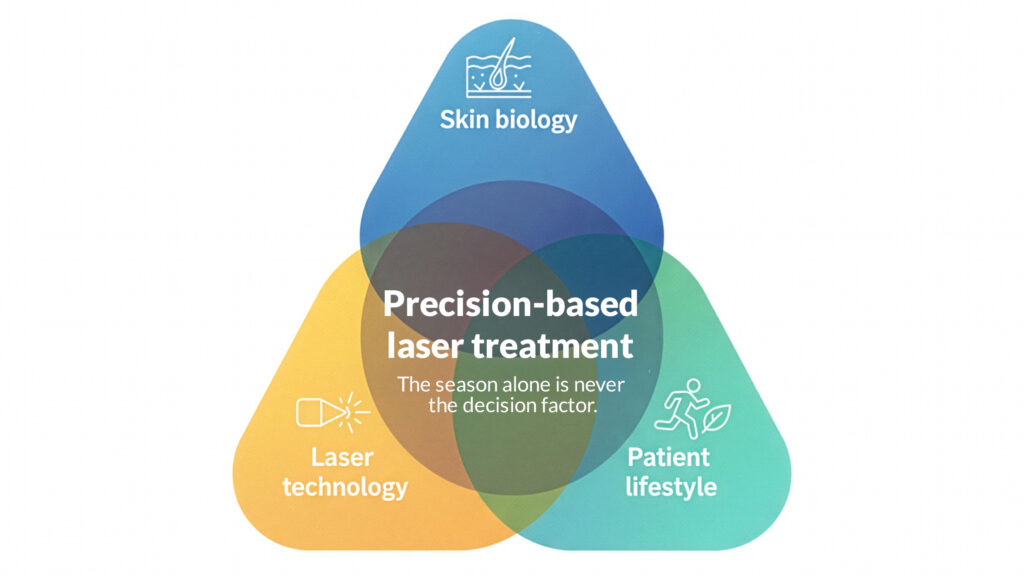
In regions with high sun exposure such as Mallorca, treatment decisions cannot be based on the calendar alone. Laser therapy is not defined by seasons, but by skin biology, laser technology and individual lifestyle factors. Successful pigmentation treatment therefore requires a differentiated, individualized approach rather than general rules.
Pigmentation is not a single condition. It represents a spectrum of changes involving melanin distribution, vascular components and inflammatory processes. Understanding these mechanisms is essential for selecting the appropriate laser technology and achieving safe, long-term results.
Patients with significant UV exposure or pigment changes should also undergo regular dermatological skin checks to exclude medically relevant lesions.
Understanding pigmentation: more than just dark spots
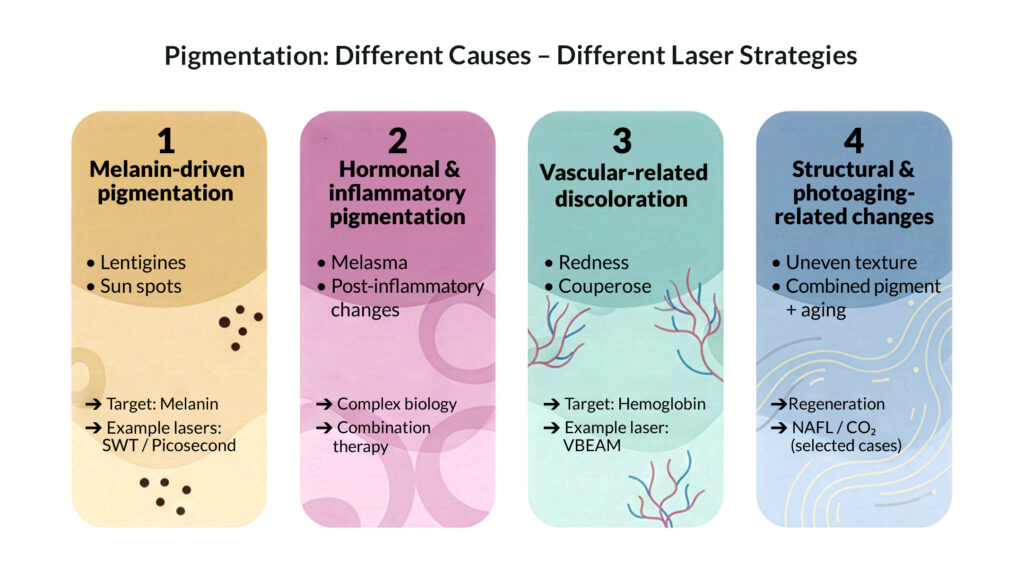
Pigment changes arise from different biological pathways. Sun-induced pigmentation such as lentigines is driven primarily by increased melanin production. Conditions like melasma involve complex hormonal and inflammatory components. Redness, couperose or post-inflammatory pigmentation often have a strong vascular contribution.
Because these mechanisms differ, no single laser technology is suitable for all types of pigmentation. Effective treatment requires precise selection of wavelength, energy delivery and treatment depth – based on diagnosis, skin type and current pigmentation status.
Clinical evaluation and targeted laser treatments for pigmentation form the basis of safe and effective therapy.
What does “spring” mean for laser treatments?
Laser safety and efficacy cannot be defined by the calendar alone. Whether a laser treatment is appropriate in spring depends on several key factors:
- the treatment goal
- the laser technology used
- the patient’s skin type
- the degree of tanning or recent sun exposure
- individual lifestyle and outdoor activity
Patients with lighter skin types, minimal tanning, consistent photoprotection and limited outdoor exposure may safely undergo even more intensive laser procedures well into spring, including ablative treatments, when medically indicated and closely supervised.
In contrast, patients with darker skin types, a tendency toward hyperpigmentation or extensive outdoor activity require significantly more caution. In these cases, lasers that directly target melanin demand careful risk assessment and adapted treatment strategies.
Selective light and vascular lasers: when precision matters
Selective wavelength light systems and vascular lasers target melanin or hemoglobin with controlled energy delivery. Their strength lies in improving diffuse pigmentation, redness and overall skin clarity while minimizing damage to surrounding tissue.
At mySkin Mallorca, selective wavelength technology such as Nordlys SWT is used for superficial pigment changes and skin tone irregularities.
For vascular components, including redness, couperose and inflammatory erythema, VBEAM pulsed dye laser technology allows precise targeting of hemoglobin rather than melanin.
In spring, these treatments can be effective for superficial pigmentation and vascular changes when combined with strict photoprotection. They are often used to improve skin tone rather than to induce deep structural remodeling.
Non-ablative fractional lasers for pigment and texture
Non-ablative fractional lasers, such as 1550 nm or 1940 nm wavelengths, stimulate controlled regeneration by creating microscopic thermal zones within the skin. This accelerates epidermal turnover and induces dermal remodeling.
These lasers are particularly useful when pigmentation is combined with early textural changes or signs of skin aging. In spring, treatments can be safely performed with appropriate settings and rigorous sun protection.
Non-ablative fractional laser concepts are summarized under non-ablative fractional laser technologies.
Picosecond lasers: targeting pigment without heat damage
Picosecond laser technology works through ultra-short pulses that generate photoacoustic effects rather than thermal injury. Pigment particles are fragmented efficiently while surrounding tissue remains largely unaffected.
Picosecond lasers are well suited for resistant pigmentation, post-inflammatory discoloration and mixed pigment conditions. In selected cases, they can be used even during periods of higher UV exposure, provided patient compliance with sun protection is excellent. At mySkin Mallorca, this approach is represented by PicoWay picosecond laser technology.
CO₂ ultrapulse laser: a powerful tool – with clear limitations
Ablative CO₂ lasers remain among the most effective technologies for pigment correction and structural skin regeneration. By removing micro-columns of tissue, they trigger profound epidermal and dermal remodeling.
However, CO₂ laser treatments increase photosensitivity and require a longer recovery phase. While they can be performed in spring in carefully selected patients, they are never routine seasonal treatments. Strict sun avoidance, excellent photoprotection and realistic downtime expectations are essential.
CO₂ laser therapy is reserved for specific indications where deeper resurfacing and long-term structural improvement are required and is performed using CO₂ Ultrapulse technology.
Photoprotection is non-negotiable
Regardless of skin type or laser modality, consistent photoprotection is mandatory for all patients undergoing laser treatment. Sun protection is not only essential to prevent pigmentation recurrence, but also to protect collagen integrity.
Ultraviolet radiation is one of the most powerful drivers of collagen degradation and biological skin aging. Without adequate sun protection, the regenerative benefits of laser treatments cannot be maintained.
Medical-grade photoprotection is an integral part of treatment planning and patient education and forms the basis of medical skincare and sun protection concepts.
In clinical practice, patients who are unwilling or unable to adhere to strict photoprotection protocols are not suitable candidates for laser therapy. This is a matter of medical responsibility and patient safety.
Conclusion: precision over general rules
Pigmentation treatment in spring requires precision, not simplification. In sun-intense regions such as Mallorca, successful laser therapy depends on individual skin biology, laser technology and patient behavior rather than on the season alone.
When treatments are selected based on skin type, pigmentation mechanism and lifestyle factors, laser treatments can be both safe and highly effective during spring. Performed under dermatological supervision and embedded in a comprehensive skin health strategy, they improve pigmentation, skin clarity and long-term skin quality without unnecessary risk.