Your 20s and 30s are often considered the “best years” for skin. Breakouts may settle, the skin still appears firm, and visible aging feels far away. From a dermatological perspective, however, this phase is not neutral – it is foundational.
In my daily practice, I see again and again that the foundations for long-term skin health are laid early – often quietly, without immediate visible consequences. Collagen decline begins gradually in the mid-20s. Ultraviolet damage accumulates long before it becomes visible. Low-grade inflammation leaves structural traces even when the skin appears calm. What we see at 45 is often the delayed result of decisions made at 25.
Premature skin aging is rarely purely genetic. In most cases, it reflects cumulative habits, skincare decisions and missed preventive opportunities. Understanding these biological patterns allows for a calmer, more realistic and evidence-based approach to skin care in young adulthood.
Mistake 1:
Over-Treating the skin instead of supporting It
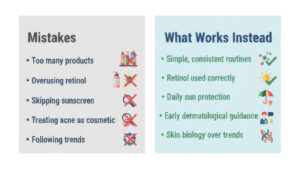
Highly complex routines, daily exfoliation and constant product changes are often perceived as sophisticated skincare. Influenced by social media trends and multi-step routines, many young patients believe they are doing their skin a favor. Clinically, however, excessive skincare is one of the most common causes of barrier disruption, chronic irritation and inflammatory skin reactions such as perioral dermatitis.
I see this particularly often in patients who are highly motivated but poorly guided. When the skin barrier is repeatedly compromised, the skin shifts into a low-grade inflammatory state. Over time, this weakens resilience and increases sensitivity. The skin in your 20s and early 30s has a strong intrinsic regenerative capacity. It does not require constant stimulation.
What matters instead:
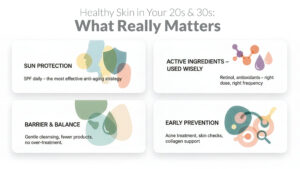
A reduced, well-chosen routine adapted to skin type, climate and lifestyle. In dermatology, controlled support is more effective than continuous intervention.
Mistake 2:
Using Retinol too early, too strong, too often
Retinoids are among the most effective and scientifically supported ingredients in dermatology. Used correctly, they improve cell turnover, support collagen metabolism and help regulate pigmentation. Problems arise almost exclusively from incorrect use: starting with concentrations that are too high, applying retinol too frequently, or combining it with multiple exfoliating actives at the same time.
In clinical reality, I rarely see true “retinol intolerance” – but very often retinol misuse. Retinol itself is not inherently dangerous. When used in the evening, introduced gradually and combined with consistent daily sun protection, it is usually well tolerated. The issue is not the molecule – it is the misconception that stronger and more frequent use automatically leads to better results.
What matters instead:
Choose the right formulation, adjust frequency rather than strength, and always combine retinol with daily sunscreen. Precision is more important than intensity.
Mistake 3:
Chasing trends instead of understanding skin biology
Skincare trends change rapidly, but skin biology does not. What works beautifully for one person may worsen acne, rosacea, pigmentation or sensitivity in another. Skin is a hormonally responsive, metabolically active organ. Stress, UV exposure, sleep quality and lifestyle influence how it behaves.
Treating skin as a trend-driven surface rather than a living biological system is one of the most common reasons patients come to my clinic frustrated and confused.
What matters instead:
Understanding your individual skin biology and adapting care accordingly – ideally with professional dermatological guidance rather than trial-and-error routines.
Mistake 4:
Underestimating Sun Protection – because damage feels invisible
In youth, tanning is often associated with health and attractiveness. Few people think about wrinkles, pigment spots or skin cancer at this stage. Medically, ultraviolet radiation is the most powerful external driver of collagen degradation and DNA damage.
The most severe and irreversible structural changes often occur early in life – during childhood, adolescence and young adulthood. This is something many of my patients only realize years later, when pigment changes or premature aging suddenly appear.
What matters instead:
Daily, consistent photoprotection is the most effective anti-aging and skin cancer prevention strategy we have. Not occasionally. Not only on vacation. Every day.
Mistake 5:
Treating Acne as a Cosmetic Issue Instead of a Medical Condition
Acne is a chronic inflammatory skin disease – not a cosmetic inconvenience. Persistent inflammation alters dermal architecture. Without early and appropriate treatment, acne can lead to scarring, post-inflammatory pigmentation and long-term barrier compromise.
In practice, I often see that patients wait too long, hoping acne will resolve on its own. Unfortunately, this increases the risk of permanent structural changes.
What matters instead:
Early dermatological evaluation and structured therapy prevent long-term damage and reduce the need for more invasive correction later.
Prevention does not mean over-treatment
From a biological perspective, collagen breakdown begins around the mid-20s. This does not justify aggressive treatment. It explains why early, carefully dosed preventive strategies can be meaningful.
In selected cases, low-dose collagen-inducing treatments or neuromodulators can help preserve skin structure. There is no fixed minimum age. In patients with strong facial muscle activity, early conservative treatment may prevent dynamic wrinkles from becoming permanently etched into the skin. Preventive dermatology is not about doing more – it is about intervening at the right time, with the right intensity.
Balance matters: not too much, not too little
Some patients overuse products and actives, while others neglect basic skincare entirely – including many young men, who often underestimate sun protection and cleansing. Healthy skincare is about balance. Over many years of practice, I have learned that a few consistent, well-adapted steps are far more effective than either extreme.
Daily habits that truly make a difference
One of the most underestimated steps is proper evening cleansing. Throughout the day, the skin accumulates sunscreen residues, pollutants and inflammatory particles. Barrier repair occurs at night. Going to bed without cleansing interferes with this regenerative phase.
What matters instead:
Gentle evening cleansing with a suitable cleanser – not soap, not aggressive detergents – supports regeneration and prepares the skin for overnight repair.
Skin Checks are part of prevention – even at a young age
Preventive dermatology also includes regular skin checks, especially for individuals with many moles or newly appearing lesions.
Skin cancer, including melanoma, does not only affect older patients. I have seen advanced cases in very young adults.
Early detection significantly improves prognosis.
A Smarter approach to skin in your 20s and 30s

Healthy skin aging is not about doing everything. It is about protecting the skin early, caring for it consistently and making decisions that respect its biology. Previous generations lacked today’s knowledge about UV damage and prevention. Today’s young adults have the advantage of understanding these mechanisms earlier.
The goal is not perfection – it is long-term skin health, structural stability and intelligent prevention.